
Drones compared with knapsack and tractor spraying
A drone is not the answer for every field. Here is a fair comparison.
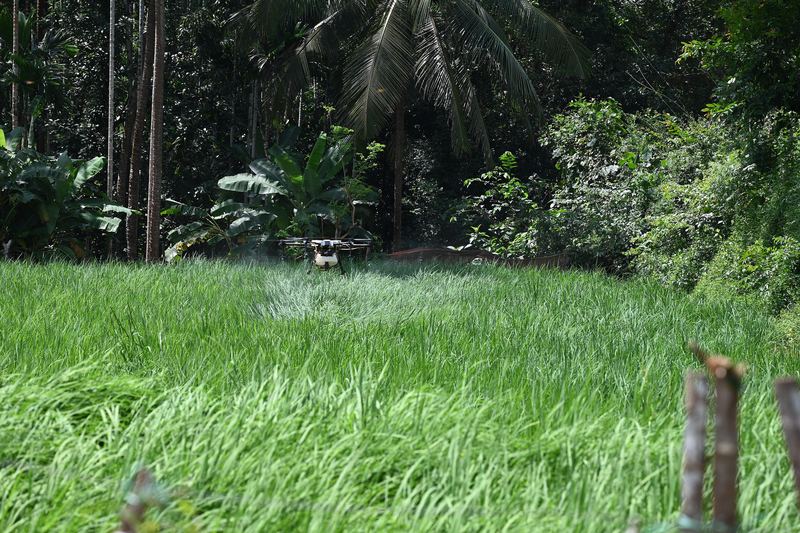

| Drone | Knapsack | Tractor / boom | |
|---|---|---|---|
| Flooded paddy | Yes, without touching the soil | Yes, but slow and heavy | Usually difficult |
| Worker exposure | Pilot at the field edge | Worker inside the spray cloud | Operator in a cab |
| Water volume | Low (20 L/ha in the IPB trial) | High (200 L/ha in the same trial) | Medium to high |
| Crop damage | No wheel tracks | Footpaths | Wheel tracks |
Numbers you can check
IPB University in Bogor recorded drone work times of 0.61 to 0.66 hours per hectare against 5.28 to 5.39 hours per hectare for manual spraying. A study in MADA paddies in Kedah, Malaysia, recorded about 24 hours in total with a drone versus about 80 hours manually, with labour going from four workers to one.
The limits
- Tank capacity is small, so refills are frequent.
- Wind and rain matter a lot.
- Not every pesticide suits aerial application; the label always decides.
Sources
- Andryan et al. (2025), Comparison of pesticide manual spraying with drone application on rice, IOP Conf. Ser.: Earth Environ. Sci. 1528 012017
- Rosedi & Shamsi (2022), Comparative Efficacy of Drone Application in Chemical Spraying at Paddy Field MADA Kedah, IOP Conf. Ser.: Earth Environ. Sci. 1059 012002